This website uses cookies. By clicking Accept, you consent to the use of cookies. Click Here to learn more about how we use cookies.
Turn on suggestions
Auto-suggest helps you quickly narrow down your search results by suggesting possible matches as you type.
Showing results for
- Extreme Networks
- Community List
- Wireless
- ExtremeWireless (Identifi)
- RE: General question about throughput and ping ms.
Options
- Subscribe to RSS Feed
- Mark Topic as New
- Mark Topic as Read
- Float this Topic for Current User
- Bookmark
- Subscribe
- Mute
- Printer Friendly Page
General question about throughput and ping ms.

Options
- Mark as New
- Bookmark
- Subscribe
- Mute
- Subscribe to RSS Feed
- Get Direct Link
- Report Inappropriate Content
10-31-2018 03:37 PM
What is the normal throughput for 2.4ghz with Extreme APs and with 5 ghz? We have users complaining of slow wifi speeds and computers on the wifi are substantially slower than wired users. Currently we are getting 35-40 mbps with iperf test when on 2.4ghz. For some reason this test could drop down to 10 on certain tests. While on 5ghz we are right around 70mbps.
Are these normal numbers?
Also while pinging from a wired PC to a Wireless device we will get alot of high ms pings then it will level out and then spike again. Is this normal behavior?
Are these normal numbers?
Also while pinging from a wired PC to a Wireless device we will get alot of high ms pings then it will level out and then spike again. Is this normal behavior?
Solved! Go to Solution.
2 ACCEPTED SOLUTIONS

Options
- Mark as New
- Bookmark
- Subscribe
- Mute
- Subscribe to RSS Feed
- Get Direct Link
- Report Inappropriate Content
10-31-2018 08:42 PM
Amazing article, Gareth!
Remember Eric, AP throughput is not real:
- "marketing" throughput is aggregated for both radios, e.g. 1,75 Gbps for 11ac Wave 1 is 450 Mbps for 2.4 GHz and 1,3 Gbps for 5 GHz; so at best you could get 1,3 Gbps (BTW that's why some push you to buy double-port APs or 2.5 G interface switches), but...
- 802.11 MAC layer overhead, beacons and retransmissions and everything else - this reduces your throughput; it can eat about 50% of PHY throughput as mentioned (we go down to around 650 Mbps here);
- AP throughput is for full utilization of it's antennas; if the AP is 3x3:3 and your device is 2x2:2 for example, you can get two third of performance at most (despite the data rate might show some high PHY based on RF signal quality);
- same applies to channel width (20/40/80 MHz); mcsindex.com is a good point to see what PHY data rates are possible with different MIMO and channel widths for different 802.11 ammendments (then signal strength based on device sensitivity and SNR will imply actual data rate for AP-STA communication);
- in the end, all APs and STAs that talk on the same or adjacent channel interfere, so it drops your throughput even more; WiFi channel is one big collision domain with no option for collision detection so far (just CSMA/CA) so when two devices happen to talk at the same time, both might have their signals falsified.
From what you say, maybe it would be good to seek for interference (ACI/CCI) on 2.4 GHz. To many APs on the same/adjacent channel? 3rd pty SSIDs on the same/adjacent channel? Other 2.4 GHz devices with heavy blow (microwave, BT, sensors)? Too many clients on the same/adjacent channel? Perhaps the APs power is too high and with your environment they could have CCI on tens/hundreds of meters? Maybe your channel re-use plan for 2.4 GHz could be finetuned? If you are able, push dual-band clients to 5 GHz.
Those are basics, greatly enahnced within the article Gareth linked here.
Besides, IMHO AP throughput shouldn't be critical if it can reach around 20-30 Mbps per client. Unless you are doing some file transfer or multimedia streaming, typical office traffic is rather of hundreds of kbps per client on average.
My personal best so far was 200 Mbps with 2x2 Intel WLAN card on my PC (867 Mbps PHY), 11ac Wave 2 AP, 5 GHz, 5-7 meters away, conference room with small to none RF footprint around and no other clients connected. I don't remember the channel width unfortunately. I will check tomorrow in our office where I get great data rates, for the sake of curiosity.
Hope that helps,
Tomasz
Remember Eric, AP throughput is not real:
- "marketing" throughput is aggregated for both radios, e.g. 1,75 Gbps for 11ac Wave 1 is 450 Mbps for 2.4 GHz and 1,3 Gbps for 5 GHz; so at best you could get 1,3 Gbps (BTW that's why some push you to buy double-port APs or 2.5 G interface switches), but...
- 802.11 MAC layer overhead, beacons and retransmissions and everything else - this reduces your throughput; it can eat about 50% of PHY throughput as mentioned (we go down to around 650 Mbps here);
- AP throughput is for full utilization of it's antennas; if the AP is 3x3:3 and your device is 2x2:2 for example, you can get two third of performance at most (despite the data rate might show some high PHY based on RF signal quality);
- same applies to channel width (20/40/80 MHz); mcsindex.com is a good point to see what PHY data rates are possible with different MIMO and channel widths for different 802.11 ammendments (then signal strength based on device sensitivity and SNR will imply actual data rate for AP-STA communication);
- in the end, all APs and STAs that talk on the same or adjacent channel interfere, so it drops your throughput even more; WiFi channel is one big collision domain with no option for collision detection so far (just CSMA/CA) so when two devices happen to talk at the same time, both might have their signals falsified.
From what you say, maybe it would be good to seek for interference (ACI/CCI) on 2.4 GHz. To many APs on the same/adjacent channel? 3rd pty SSIDs on the same/adjacent channel? Other 2.4 GHz devices with heavy blow (microwave, BT, sensors)? Too many clients on the same/adjacent channel? Perhaps the APs power is too high and with your environment they could have CCI on tens/hundreds of meters? Maybe your channel re-use plan for 2.4 GHz could be finetuned? If you are able, push dual-band clients to 5 GHz.
Those are basics, greatly enahnced within the article Gareth linked here.
Besides, IMHO AP throughput shouldn't be critical if it can reach around 20-30 Mbps per client. Unless you are doing some file transfer or multimedia streaming, typical office traffic is rather of hundreds of kbps per client on average.
My personal best so far was 200 Mbps with 2x2 Intel WLAN card on my PC (867 Mbps PHY), 11ac Wave 2 AP, 5 GHz, 5-7 meters away, conference room with small to none RF footprint around and no other clients connected. I don't remember the channel width unfortunately. I will check tomorrow in our office where I get great data rates, for the sake of curiosity.
Hope that helps,
Tomasz

Options
- Mark as New
- Bookmark
- Subscribe
- Mute
- Subscribe to RSS Feed
- Get Direct Link
- Report Inappropriate Content
04-23-2026 11:59 AM
The numbers you’re seeing on 2.4GHz (35–40 Mbps with occasional drops to 10 Mbps) and ~70 Mbps on 5GHz can be considered within a normal range depending on interference, channel width, and AP density. 2.4GHz is especially prone to congestion and performance fluctuations, which also explains the ping spikes you’re seeing between wired and wireless devices. This kind of jitter usually comes from interference, roaming behavior, or airtime contention rather than a hardware fault. Interestingly, in gaming communities, performance scaling matters a lot too—for example in manok na pula max level all chicken, progression and efficiency depend heavily on optimizing resources and timing strategies.
18 REPLIES 18

Options
- Mark as New
- Bookmark
- Subscribe
- Mute
- Subscribe to RSS Feed
- Get Direct Link
- Report Inappropriate Content
11-02-2018 06:31 PM
You could also set the ssh timeout to 0 on the AP so you don't get kicked out of the session.
cset sshTimeout 0
capply
csave
cset sshTimeout 0
capply
csave
Options
- Mark as New
- Bookmark
- Subscribe
- Mute
- Subscribe to RSS Feed
- Get Direct Link
- Report Inappropriate Content
11-02-2018 06:31 PM
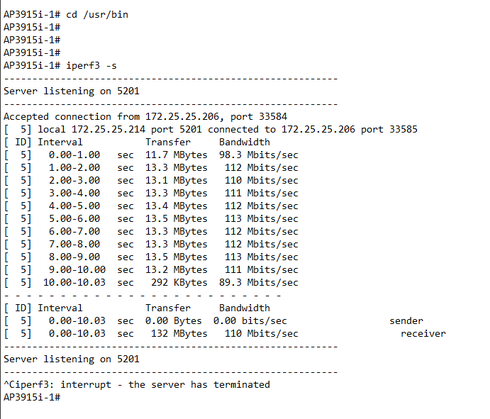
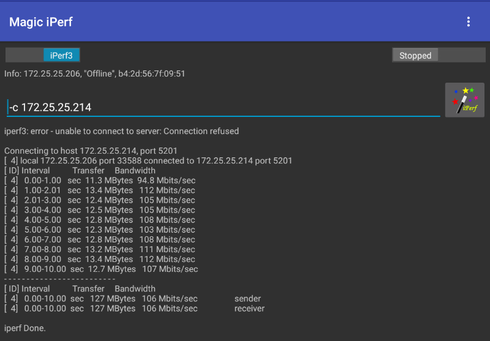
Yes but there are some requirements...
- AP model = AFAIK only AP39xx have iperf3 installed
- the wirless client must be able to reach the AP IP = the best is to setup a SSID with bridge@AP untagged so both are in the same subnet
Then ssh to the AP and switch in the /usr/bin directory and start the iperf server with "iperf3 -s"
Now you'd need a iperf3 app on the client and start the iperf-client to run the test.
Example below - hardware AP3915i and Amazon Fire D10
AP:
Amazon Fire HD10:
- AP model = AFAIK only AP39xx have iperf3 installed
- the wirless client must be able to reach the AP IP = the best is to setup a SSID with bridge@AP untagged so both are in the same subnet
Then ssh to the AP and switch in the /usr/bin directory and start the iperf server with "iperf3 -s"
Now you'd need a iperf3 app on the client and start the iperf-client to run the test.
Example below - hardware AP3915i and Amazon Fire D10
AP:
Amazon Fire HD10:
Options
- Mark as New
- Bookmark
- Subscribe
- Mute
- Subscribe to RSS Feed
- Get Direct Link
- Report Inappropriate Content
11-01-2018 07:06 PM
Thanks for the reply everyone. As far as config goes we set our channels based on site survey so they are all staggered, sitting at 20 mhz channel width, the APs are AP3825i, latest firmware. I basically copied config from this doc.
https://extremenetworks2com.sharepoint.com/:x:/r/sites/kcs/_layouts/15/WopiFrame.aspx?guestaccesstok...
I moved channel width to 80mhz and was able to achieve a file copy speeds of 25 - 30 mbps vs 10 -15 mbps as before on 20 mhz. Iperf3 of 84 -100mbps.
If your saying those speeds are normal than I will focus my efforts elsewhere. Thanks
https://extremenetworks2com.sharepoint.com/:x:/r/sites/kcs/_layouts/15/WopiFrame.aspx?guestaccesstok...
I moved channel width to 80mhz and was able to achieve a file copy speeds of 25 - 30 mbps vs 10 -15 mbps as before on 20 mhz. Iperf3 of 84 -100mbps.
If your saying those speeds are normal than I will focus my efforts elsewhere. Thanks

Options
- Mark as New
- Bookmark
- Subscribe
- Mute
- Subscribe to RSS Feed
- Get Direct Link
- Report Inappropriate Content
11-01-2018 04:21 PM
More food for thought on this subject and comparing wired vs. wireless performance:
https://gtacknowledge.extremenetworks.com/articles/Solution/Wi-Fi-Performance-Megabits-per-second-vs...
https://gtacknowledge.extremenetworks.com/articles/Solution/Wi-Fi-Performance-Megabits-per-second-vs...

Options
- Mark as New
- Bookmark
- Subscribe
- Mute
- Subscribe to RSS Feed
- Get Direct Link
- Report Inappropriate Content
10-31-2018 08:56 PM
I would be curious to know more about your deployment also. I had a similar issue with some 2.4 only clients that showed up on 3825's but not 3935's. Basically attributed it to low end wifi cards, but would be interested to know more about your deployment.

